Apple Podcasts is the undisputed pioneer of the Podcast industry. Even in 2026, getting listed on Apple is the most critical step for your show’s growth, as hundreds of smaller podcast directories pull their data directly from Apple’s database. If you are on Apple, you are everywhere.
However, Apple maintains the strictest quality control in the audio industry. They do not host your audio files; instead, they read a specialized RSS document. If your code is missing a single mandatory tag, or if your image is one pixel too small, your submission will be instantly rejected. By following all Apple Podcasts RSS feed requirements, you secure your spot in their massive directory.
Don’t risk a rejection that delays your launch. Use our free Podcast RSS Validator to check your link instantly. Our tool scans your URL against the exact Apple Podcasts RSS feed requirements and highlights any missing tags or image size errors before you submit.
Run Free RSS Validation →To save you from the frustration of endless error messages, we have compiled the ultimate diagnostic checklist. Let us break down the exact Apple Podcasts RSS feed requirements you must fulfill to get published today.
Phase 1: Server & Audio Technical Specs
Before Apple even looks at your podcast title or artwork, their servers ping your hosting environment. If your basic technical foundation fails these Apple Podcasts RSS feed requirements, the crawl stops immediately.
1. HTTPS Protocol
Your RSS feed URL and all of your audio file links (inside your enclosure tags) must begin with https://. Apple no longer accepts standard HTTP connections for security reasons.
2. Byte-Range Requests
Your audio hosting server must support HTTP HEAD requests and byte-range requests. This allows listeners to stream the audio smoothly, seek forward, and pause without downloading the entire file at once.
While meeting the basic Apple Podcasts RSS feed requirements gets your show listed, your audio quality keeps listeners engaged. Apple officially recommends mastering your audio to a specific loudness level. If your audio is too quiet, listeners will complain. We highly recommend reading our deep dive on Podcast Loudness Standards (LUFS Explained) to ensure your exported MP3 files meet Apple’s rigorous playback standards.
Phase 2: Podcast Cover Art Requirements
Image errors are the number one reason podcasts get rejected. Apple enforces incredibly strict visual standards to ensure your show looks stunning on Retina displays, iPhones, and Apple CarPlay. Failing the image check means failing the Apple Podcasts RSS feed requirements.
If you upload a low-resolution logo, Apple will reject it. Your cover art must meet these exact Apple Podcasts RSS feed requirements:
- Dimensions: Exactly square. Minimum 1400 x 1400 pixels. Maximum 3000 x 3000 pixels (3000×3000 is highly recommended).
- Color Space: RGB (Do not use CMYK, which is for print).
- Format: JPEG or PNG only.
- File Size: Keep it optimized, preferably under 500KB to ensure fast loading on mobile networks.
👉 Test your image right now using our Podcast Cover Art Checker to ensure it fits Apple’s safe zones perfectly.
Phase 3: The Mandatory iTunes XML Tags
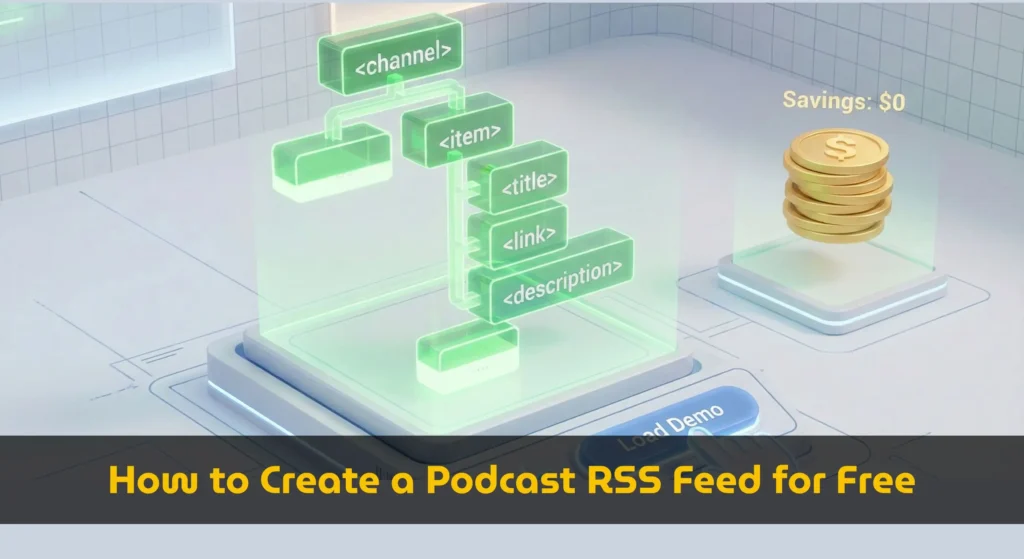
An RSS feed is simply a text file written in XML. However, standard blog RSS feeds do not work for podcasts. To successfully pass the Apple Podcasts RSS feed requirements, your code must declare the “iTunes Namespace” and include specific <itunes> tags.
<channel>
<title>The Daily Tech Show</title>
<itunes:author>Jane Doe</itunes:author>
<itunes:email>hello@example.com</itunes:email>
<itunes:category text=”Technology”/>
</channel>
</rss>
The Core Tags You Cannot Miss:
-
<title>&<itunes:author>: The name of your show and your name. Do not stuff keywords here (e.g., “Tech Show | Startup | Business”). Apple actively bans shows for keyword stuffing, strictly enforcing their Apple Podcasts RSS feed requirements. -
<itunes:email>: This is critical. Apple uses this exact email address to verify your ownership when you submit your feed to Apple Podcasts Connect. They will send a mandatory verification code to this address. -
<itunes:category>: You must select an exact category from Apple’s official list (e.g., “Business”, “True Crime”). You cannot invent your own categories. -
<itunes:explicit>: You must declare whether your show contains profanity. Acceptable values are “true” or “false”. If you use profanity and mark it false, your show will be permanently removed.
Writing XML code by hand is prone to catastrophic syntax errors. If you don’t have a feed yet, you can use our Podcast RSS Feed Generator to build a link that meets all Apple Podcasts RSS feed requirements for free. It automatically structures the iTunes Namespace, injects the mandatory email tags, and embeds your cover art correctly.
Build Your RSS Feed Now →Phase 4: Episode-Level Requirements (The <item> Tag)
Every time you publish a new episode, you are adding an <item> block to your RSS feed. To satisfy the Apple Podcasts RSS feed requirements, each episode must contain the following specific data:
The Enclosure Tag
This is where your audio lives. You must provide the URL, the exact file length in bytes, and the audio type (e.g., type="audio/mpeg" for MP3s).
Episode Summaries
You must include an <itunes:summary> tag. This is the description listeners read before hitting play. It should be compelling and SEO-friendly, but plain text (avoid excessive HTML).
Duration Tag
The <itunes:duration> tag tells Apple exactly how long the episode is (formatted as HH:MM:SS). If missing, Apple’s player UI will glitch.
Phase 5: The “Gold Standard” for Other Platforms
Why do we focus so heavily on the Apple Podcasts RSS feed requirements? Because Apple is the foundational directory of the podcasting universe. If your RSS feed successfully passes Apple’s validation, it is virtually guaranteed to be accepted by every other major platform on the internet.
For example, when you are ready to submit to Spotify, their ingestion engine looks for the exact same iTunes namespace tags (like <itunes:image> and <itunes:summary>) that you just optimized for Apple. If you want to expand your reach, you can seamlessly use your Apple-compliant feed to conquer Spotify. Read our complete guide on How to Submit Your Podcast to Spotify using an RSS Generator to scale your audience across both giants.
Frequently Asked Questions (FAQ)
Why does Apple say “Can’t read your feed”?
This generic error means your XML structure violates the Apple Podcasts RSS feed requirements. It usually happens if you hand-coded your feed and forgot a closing tag (like </channel>), or if you used invalid characters like an unescaped ampersand (&). Always run your feed through our free validation tool before submitting.
Do I need to host my own RSS feed to meet Apple Podcasts RSS feed requirements?
No, you don’t have to code it yourself. While understanding the Apple Podcasts RSS feed requirements is crucial for troubleshooting, you can generate the code automatically. By using our Podcast RSS Feed Generator, you can ensure 100% compliance with Apple’s developer guidelines without typing a single line of XML.
How long does Apple Podcasts approval take once requirements are met?
If your feed perfectly matches all Apple Podcasts RSS feed requirements, approval typically takes between 24 and 72 hours. Unlike Spotify, which is automated, Apple utilizes human reviewers to ensure your content and artwork meet their strict quality and copyright standards.
Don’t Guess. Validate.
Submitting a broken feed can delay your podcast launch by weeks. Check your feed health right now to ensure absolute compliance with all Apple Podcasts RSS feed requirements.
Validate Your Podcast RSS Now →